
Traders said gold prices surged on hectic buying by stockists for the marriage season and weak rupee against the dollar, making the precious metal costlier.

Globally, gold advanced 0.3 per cent to USD 1,179.35 an ounce in Singapore.

Silver also lacked necessary follow-up support from industrial units and coin makers and lost Rs 300 to end at Rs 43,000 per kg.

With the listing of Reliance gold ETF on the National Stock Exchange (NSE) on Wednesday, four fund houses (Benchmark, UTI Mutual Fund and Kotak Mutual Fund being the other three) currently offer gold ETFs to Indian investors.
Companies change the way they calculate the value of gold, leading to a lower loan-to-value for customers.

'Consider 40% to 50% in equities, 10% in gold as a hedge, and the remaining 30% to 40% split between multi-asset funds and hybrid funds.'
Gold prices will rise next year as the financial crisis pushes more investors into the precious metal safe haven, according to delegates polled on Tuesday during the London Bullion Market Association annual meeting in Kyoto.

Gold in New York, which normally sets price trend on the domestic front, fell 0.46 per cent to $1,288.20 an ounce and silver by 0.84 per cent to $20.13 an ounce in yesterday's trade.
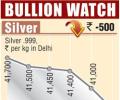
Sentiments remained bearish as gold fell to 16-week low in the overseas markets as positive US economic data backed the case for the Federal Reserve to keep on reducing monetary stimulus which has dimmed the metal's appeal.
.JPG)
Silver followed suit and lost Rs 645 at Rs 42,880 per kg on reduced offtake by industrial units and coin makers.
.jpg)
Gold, which had surged after government decided to increased import duty, lost Rs 125 to Rs 29,700 per 10 grams.

Silver also fell further by Rs 150 to Rs 34,200 per kg.

Traders said profit-selling by stockists at prevailing higher levels against sluggish demand mainly led to decline in gold prices.

Gold prices surged by Rs 150 to trade at fresh three-month high of Rs 27,575.
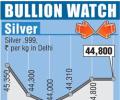
Silver, however, recovered by Rs 50 to Rs 36,800 per kg

Bullion merchants said persistent rise in gold prices is mostly due to a firming trend in global markets as concerns over European economy mounted, spurring demand for safe-haven, and increased buying by jewellers to meet wedding season demand at domestic spot markets.
Govt raises import duties again, misses the point.

'Assess the property in terms of type, size, location and price point, and whether it fits into your budget.' 'If it checks out on these fronts, one may consider the accompanying offers.'

Gold prices could go up 12.5 per cent and touch $1,800 per ounce in the second half of 2012, according to the Thomson Reuters GFMS Gold Survey, released in Beijing on Tuesday. Improved investment sentiment for gold will help drive prices up, said the survey. Presently, gold is trading at $1,600.
UTI Mutual Fund recently launched Gold Exchange Traded Funds and many more companies plan to follow suit. Get the lowdown.
Traders said slackness in demand from retailers and jewellers at current levels mainly led to decline in gold prices.

Here's how to own your dream home without paying excessive interest on your EMIs.
Gold prices plunged to over ten months low by losing Rs 505 to Rs 29,470 per ten gram in the national capital on Thursday on frantic selling by stockists amid restricted buying, driven by a steep fall in overseas markets.

After completing four days of gains, gold prices spurted here by Rs 400 today to regain the psychological level of Rs 28,000 per ten grams on sustained seasonal buying amid a firming global trend.
Price up on weak dollar and strong demand

Antonio Watson won a thrilling World Championship 400 metres gold on Thursday.
Ten years ago, gold was selling at well below its long-term inflation-adjusted average, and the integration of three billion emerging market citizens into the global economy could only mean a giant long-term boost to demand.
Stocks continue to outshine gold and silver when it comes to adding to investors' wealth by giving 8 per cent return so far this year.
Gold prices dropped at the bullion market on Thursday on selling by stockists and traders following mute demand due to prevailing high prices and lower global cues.
Bullion in the Asian region gained as much as 0.5 per cent to $1,222.47 an ounce, its highest level since May 19, as the euro extended its 2.4 per cent decline against the dollar last week.

According to its owners, its value has multiplied several times over the years, because of the record gold price now.

With Valentine's Day falling on a Friday, travel is picking up as people look for quick getaways.

A dedicated physical gold exchange could lead to standard gold pricing in India.

Globally, gold prices slipped by 0.26 per cent to $1,246.20 an ounce in early trade in London.

Traders said sustained buying by stockists to meet the festive and marriage season demand mainly helped gold prices to extend gains for the second session.
The direction of gold prices will depend on central banks, bullion banks and leveraged hedge funds.

Demand to remain high with festive season ahead and ongoing price fall

Analysts say investors should increase their exposure to gold up to 10% of their portfolio, depending on their comfort with a 2-year horizon. But avoid investing in physical gold or deposit schemes run by jewellers

Traders said lack of buying support from retailers and jewellers who preferred to keep their activity restricted, anticipating further fall in coming days, mainly kept gold prices unchanged.
